Why AI Should Not Be Used for Finance Tools | Risk of AI Math

Generative artificial intelligence has transformed code generation, copy editing, and conversational search. However, relying on large language models (LLMs) to perform mathematical calculations for loans, mortgages, retirement planning, or tax obligations is a dangerous mistake. Because neural networks predict text statistically rather than executing arithmetic formulas, they routinely produce plausible-sounding hallucinations, off-by-cents rounding errors, and non-deterministic results. For financial decisions where every penny counts, you should always use verified, formula-backed tools such as our free Compound Interest Calculator rather than probabilistic AI prompts.
Error Tolerance in Financial Audits
LLM Failure Rate on Multi-Step Math
Deterministic Engine Speed
Formula Repeatability
The Core Conflict: Probabilistic Sampling vs. Deterministic Arithmetic
To understand why generative AI struggles with financial math, it helps to look at how large language models function under the hood. An LLM does not contain a calculator or a financial spreadsheet engine by default. Instead, it is a massive statistical pattern matcher trained to predict the most probable next token (word, punctuation, or number) based on context.
When you ask an AI model, "What is the monthly payment on a $425,000 loan at 6.75% for 30 years?", the model does not natively solve the annuity formula:
Instead, the model generates digits that look statistically similar to mortgage calculations it encountered in its training corpus. Unless connected to an active code execution sandbox, the model guesses the numerical sequence. Even minor discrepancies in intermediate decimal precision or monthly compounding fractions yield figures that look authoritative but are factually wrong.
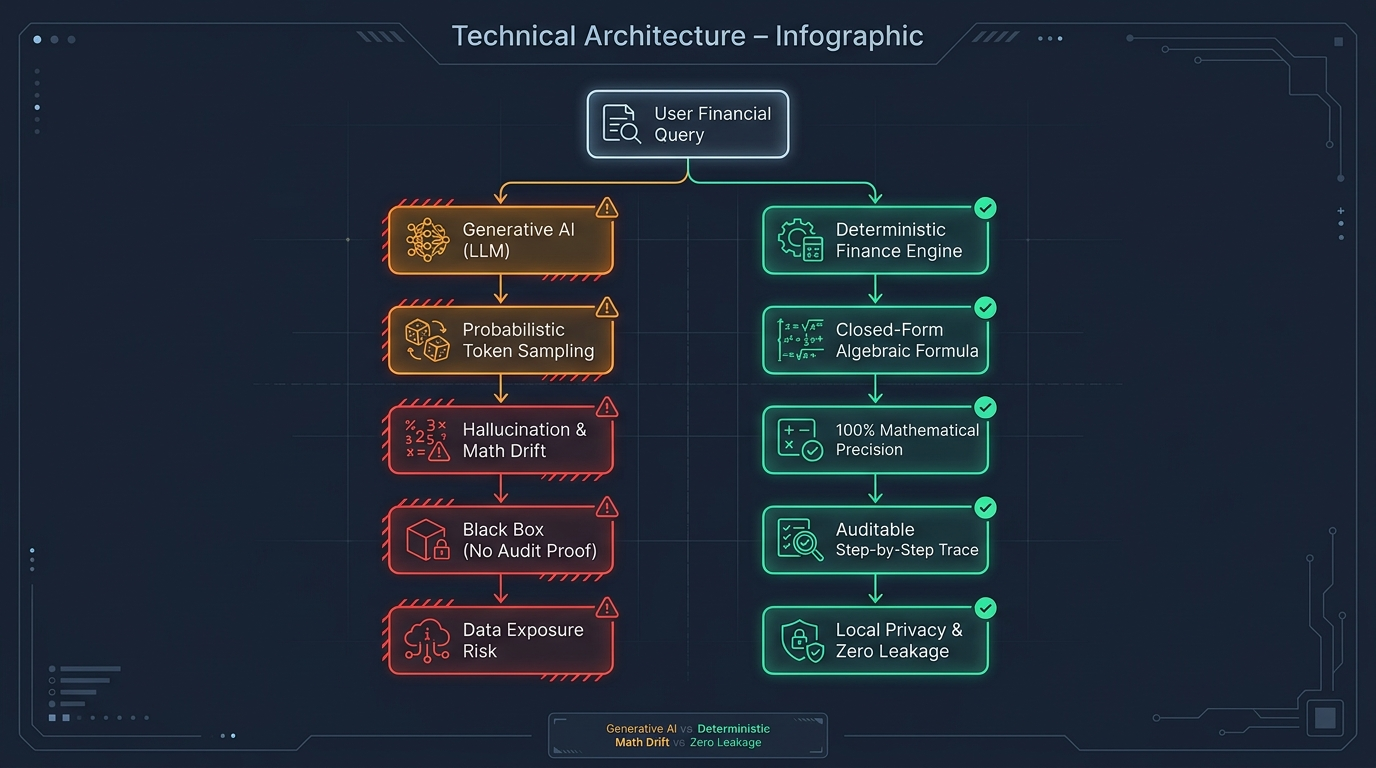
Figure 1: Architectural comparison between probabilistic LLM generation (prone to hallucination, drift, and data exposure) and deterministic financial engines (delivering exact formulas, repeatable accuracy, and client-side privacy).
The 5 Fatal Risks of Using AI for Financial Calculations
When evaluating financial software or personal budgeting tools, relying on AI models introduces five distinct failure modes:
1. Hallucinations and Confabulated Constants
Generative models are prone to hallucination: generating convincing statements, tax rules, or interest rates that have no basis in reality. In finance, this can mean an AI misquoting statutory 401(k) contribution caps, fabricating state tax deductions, or applying standard amortization rules to specialized loans with balloon payments.
2. Compounding Rounding Drift
In financial calculations, order of operations and exact fractional rounding are critical. A tiny deviation of 0.05% in monthly interest compounding might appear harmless on paper, but across a 30-year amortization schedule or an index fund investment, it compounds into a discrepancy of tens of thousands of dollars. Pure AI models lack the rigorous IEEE 754 precision guarantees enforced by dedicated financial software.
3. The Black Box Problem and Lack of Audit Trails
Regulatory standards such as the Truth in Lending Act (TILA), Consumer Financial Protection Bureau (CFPB) guidelines, IRS compliance rules, and Sarbanes-Oxley (SOX) require an auditable, reproducible paper trail. When a bank, accountant, or taxpayer calculates numbers, they must show the exact algebraic equation and schedule. An LLM cannot provide a verifiable proof of its internal weights; it cannot prove why it chose one digit over another.
4. Non-Deterministic Consistency (Stochastic Drift)
If you run a formula through a deterministic calculator 1,000 times with identical inputs, you receive the exact same result down to the penny 1,000 times. With generative AI models, temperature settings, top-p sampling, and system prompt variations cause non-deterministic behavior. Asking the exact same financial question in two separate conversation threads frequently returns two different monthly totals.
5. Data Privacy and Confidentiality Exposure
Pasting personal financial information (annual salaries, outstanding debt amounts, tax identification numbers, or account statements) into consumer AI chatbots exposes confidential data to cloud logging, model retraining, and potential third-party leaks. In contrast, client-side financial calculators process calculations locally in your browser without transmitting your net worth or debts across the internet.
Generative AI vs. Deterministic Financial Calculators
The table below highlights the core structural differences between probabilistic AI systems and deterministic calculation engines:
| Evaluation Metric | Generative AI (LLMs) | Deterministic Calculators |
|---|---|---|
| Calculation Engine | Probabilistic token prediction | Closed-form algebraic formulas |
| Mathematical Accuracy | Variable (prone to math hallucination) | 100% exact to the penny |
| Auditability & Transparency | Opaque neural network weights | Clear formulas and full schedules |
| Compliance Readiness | Fails TILA, IRS, and CFPB standards | Compliant with financial regulations |
| Data Privacy | Data often logged or sent to cloud APIs | Processed locally in browser memory |
| Response Latency | 1 to 5 seconds per request | Sub-millisecond (instant) |
How to Calculate Financial Figures Accurately
To ensure your loans, investments, and taxes are calculated without errors, use deterministic calculation approaches:
Method 1: Use Verified Client-Side Financial Calculators
Dedicated online calculators use compiled JavaScript or backend code executing exact formulas. For example, our free Compound Interest Calculator computes future principal, accrued interest, and optional monthly contributions using standard financial equations:
- Input exact variables: Enter your principal amount, expected annual percentage rate, and investment timeline.
- Select compounding frequency: Choose whether interest compounds annually, semi-annually, quarterly, monthly, or daily.
- Review instant schedules: Inspect the transparent month-by-month or year-by-year growth breakdown with zero rounding drift.
Method 2: Use Dedicated Multi-Tool Financial Suites
When you need comprehensive, multi-scenario financial modeling without the risks of AI hallucination, specialized calculation platforms are the gold standard. For dedicated personal and business calculations, platforms like Finance Calc Kit provide an extensive collection of deterministic, formula-checked calculators for mortgages, debt consolidation, CD yields, and retirement projections.
Method 3: Build Validated Spreadsheet Models
If you are designing custom financial models, use standardized spreadsheet applications like Microsoft Excel or Google Sheets. These platforms utilize battle-tested financial functions rather than language predictions:
=PMT(rate, nper, pv): Calculates regular loan payments based on constant payments and a constant interest rate.=FV(rate, nper, pmt, [pv]): Computes the future value of an investment with periodic contributions.=NPER(rate, pmt, pv): Determines the exact number of payment periods required to clear a debt.
Where AI Does Belong in Personal Finance
Pointing out the computational limitations of AI does not mean machine learning has no role in finance. AI models excel at linguistic tasks and data extraction, provided they are not performing raw arithmetic:
- Summarizing financial contracts: AI is effective at scanning 80-page loan disclosures to highlight prepayment penalties or restrictive clauses.
- Translating financial terminology: Explaining the conceptual difference between APR and APY in accessible plain language.
- Optical Character Recognition (OCR): Parsing line items from receipts or PDF statements to feed into a deterministic ledger.
The golden rule is straightforward: use artificial intelligence to explain concepts, read documents, and draft questions, but always delegate the actual calculations to dedicated, deterministic tools.
Related Free Financial Tools
- Compound Interest Calculator: Calculate exponential investment growth with monthly contributions.
- Advanced Loan Calculator: Model total interest, monthly installments, and payoff timelines.
- Amortization Calculator: Generate complete payment schedules dividing principal and interest.
- Debt Payoff Calculator: Compare snowball and avalanche repayment strategies.
- 1099 Tax Calculator: Estimate self-employment and income tax obligations accurately.
Frequently Asked Questions
Why do AI models make mistakes on simple financial math?
Large language models predict text sequences probabilistically rather than evaluating algebraic equations. Without an integrated code sandbox, the model generates numbers that statistically resemble financial answers but often contain arithmetic errors.
Can AI be used if it uses a code interpreter or Python tool?
When an AI executes actual Python or JavaScript code in a sandbox, the calculation itself becomes deterministic. However, the model can still introduce errors if it writes the wrong formula, misinterprets user parameters, or fails to verify statutory compounding rules.
What are the legal and compliance risks of using AI for finance?
Regulations like TILA and CFPB rules require clear, auditable calculations for interest rates, APRs, and repayment schedules. Because AI models operate as black boxes without formal mathematical proofs, their outputs cannot satisfy legal audit requirements.
Is it safe to paste personal financial data into an AI chatbot?
No. Uploading pay stubs, account balances, or debt figures to public AI chatbots can expose sensitive information to cloud logs and training pipelines. Deterministic client-side calculators run directly in your browser without saving or transmitting your data.
Precision in finance is not optional. A single misplaced decimal or hallucinated compounding factor can derail a retirement timeline or distort a mortgage commitment. Protect your financial health by relying on transparent, formula-driven calculators: start with our free Compound Interest Calculator for dependable, verified math.