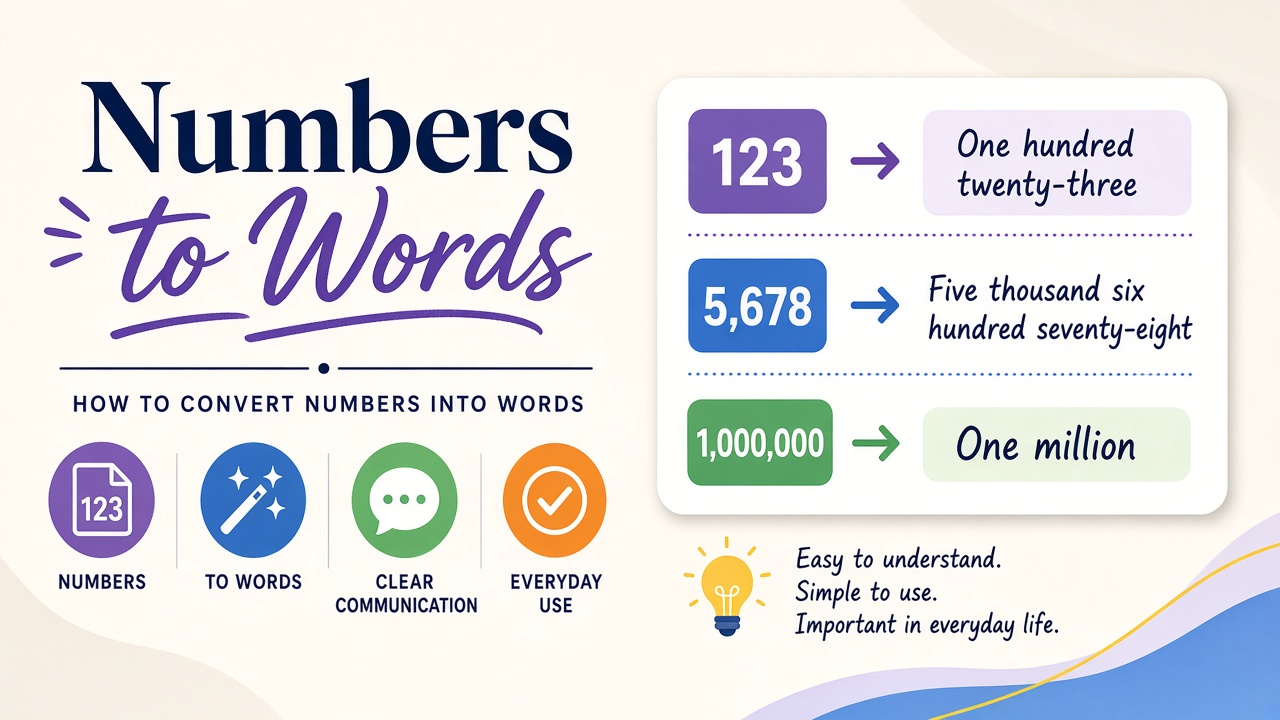
Numbers to words conversion turns digits like 1,250.50 into spelled-out English such as one thousand two hundred fifty and fifty/100. You need this for paper checks (where written words can override conflicting figures), contracts, tenders, school worksheets, and invoice templates that include an "amount in words" line. This guide explains when spelled-out amounts are legally required, how US check wording differs from British English, short scale vs long scale, and how to use our free Numbers to Words converter in your browser with no sign-up.
Words Can Prevail
Quadrillion Scale
Browser-Only
Letter Case Options
Key facts: numbers to words (quick reference)
Use this block when you need a concise answer for search or AI summaries:
- Number to words means writing the same value in English words instead of Arabic numerals (e.g. 42 → forty-two).
- US checks: If the numeric box and the written line disagree, US banking guidance states that words prevail over numbers (see HelpWithMyBank.gov).
- Many VAT invoices in the UK, EU, India, and UAE require monetary figures but do not universally require a written-out total; always follow your customer, tender, or template.
- China officially requires invoices to show value in words and figures among other elements (State Taxation Administration guidance).
- Short scale (US, UK modern usage): billion = 109. Long scale (some European languages historically): billion = 1012. Our tool uses short scale English.
- Decimals: Common US check style uses
and XX/100for cents; our converter spells the cent value in words before/100(e.g. 1.50 → one and fifty/100).
What is a numbers to words converter?
A numbers to words converter (also called number to words or convert number to words) automates English spelling for integers, decimals, and negatives. Instead of mentally decomposing place values (thousands, millions, billions), you paste a figure and copy the result into a check line, contract exhibit, or invoice field labeled "Total in words."
People search for numbers to words when they need to:
- Write a check or bank draft without risking a mismatch between figures and prose.
- Fill legal or financial PDFs that include "amount in words" next to a numeric total.
- Prepare tenders or government forms that mandate spelled-out currency lines.
- Teach or grade place value in elementary math (number names, hyphenation rules).
- Validate data entry by comparing stored numerics with written amounts in scanned documents.
- Improve accessibility by providing word forms for screen readers alongside digits.

Figure 1: Typical numbers-to-words workflow from input to copy-ready text.
When must amounts be written in words?
Requirements depend on document type and jurisdiction. The table below is a practical guide, not legal advice. Confirm with your accountant, counsel, or the form issuer.
| Document or context | Spelled-out amount? | Notes |
|---|---|---|
| US personal/business checks | Expected | Written line is a primary control; words override conflicting numerics per US banking guidance. |
| UK / EU VAT invoices (typical) | Usually optional | EU VAT Directive Article 226 lists taxable amounts and VAT in figures; a written total is not a standard mandatory line. |
| India GST invoices (Rule 46) | Usually optional | Rule 46 specifies numeric tax breakdowns; many templates still add words for clarity. |
| China fapiao / invoices | Required | Official invoice elements include value in words and figures. |
| Contracts & loan agreements | Often required | Defined amounts may appear twice (figures + words) to reduce ambiguity. |
| Corporate ERP / customer PO templates | Varies | Follow the field label: "Total in words" must match the total field, not the subtotal. |
How English number spelling works (short scale)
Standard US English uses the short scale naming system. Each group of three digits maps to a scale word:
- Ones (1–9): one, two, three … nine
- Teens (10–19): ten, eleven, twelve … nineteen
- Tens (20–99): twenty, thirty … ninety (hyphenate with ones: twenty-one)
- Hundreds (100–999): five hundred twenty-one
- Thousands, millions, billions, trillions, quadrillions: compose left to right without "and" between major groups in US style (e.g. three million four hundred thousand two).
Hyphenation: Use a hyphen for compound tens-ones (forty-five, ninety-nine). Do not hyphenate "one hundred" or scale words.
Negative values: Prefix with negative (e.g. -42 → negative forty-two).
Zero: The integer 0 is zero.
Worked examples (figures → words)
| Numeric input | Words (lowercase, tool output) | Typical use |
|---|---|---|
| 89 | eighty-nine | Small check; verify words match the box amount. |
| 1250.50 | one thousand two hundred fifty and fifty/100 | Payroll or vendor check with cents. |
| 1000000 | one million | Contract cap, grant limit, or headline figure. |
| 2025 | two thousand twenty-five | Year or invoice reference spelled out in prose. |
| -15.75 | negative fifteen and seventy-five/100 | Credit memo or adjustment line. |
For check memos, some banks expect the fraction to use two digits (50/100) rather than spelled cents. Our tool prioritizes consistent English spelling; you can edit the fraction digits after copying if your institution requires numeric cents in the fraction.
Conversion methods compared
| Method | Best for | Privacy | Speed |
|---|---|---|---|
| OnlineMiniTools Numbers to Words | Checks, forms, quick copy-paste | Runs in browser | Instant |
| Excel / Sheets custom function | Bulk rows in spreadsheets | Local file | Fast at scale |
Python num2words library |
ETL pipelines, apps, localization | Your infrastructure | Scriptable |
| Manual spelling | Very small integers, exams | N/A | Error-prone |
Method 1: Use the free Numbers to Words tool (easiest)
The Numbers to Words converter on OnlineMiniTools updates as you type. Processing stays in your browser (JavaScript), which matters when you work with payroll totals, settlement amounts, or unreleased contract values.
- Open the tool and enter the numeric value in the Enter Number field. Whole numbers, decimals, and negatives are supported.
- Choose letter case: lowercase for body text, Title Case for formal lines, or UPPERCASE when a form demands block capitals.
- Read the result card on the right. It refreshes automatically; no submit button.
- Copy the wording into your check, PDF, or invoice. Draw a line through unused space on checks to deter alteration.
- Cross-check that the words match the exact field (total vs amount due vs subtotal) and currency.
The converter supports values up through quadrillions on the short scale. Extremely large inputs may hit JavaScript floating-point limits; for mission-critical astronomical figures, verify with a second method.
Method 2: Excel or Google Sheets (bulk)
For dozens of rows, spreadsheet add-ins or custom VBA / Apps Script functions that call a number-to-words routine save time. Export CSV from accounting software, generate a words column, and merge into mail-merge checks. Keep locale in mind: British English often inserts "and" before the final group (one hundred and twenty-three), while US check style typically omits internal "and" except before cents.
Method 3: Python for developers
In application code, libraries such as num2words (PyPI) generate localized prose. Use them in invoice PDF generators, test fixtures, or CLI utilities. Always pin language (lang='en') and test edge cases (0, negatives, rounding).
# Example: pip install num2words
from num2words import num2words
num2words(1250.50, lang='en')  # adjust for your locale rules
Invoice wording: match the right field
Invoices often show several monetary lines. The spelled-out line must mirror the label beside it:
- Total amount in words → matches invoice total including tax and charges.
- Amount due in words → matches balance after payments, not the subtotal.
- Subtotal in words → rare; only if the template explicitly asks for subtotal wording.
Mixing fields is a common accounts-payable rejection reason. Generate words from the final number you display in the paired numeric box.
US check writing checklist
- Write the payee name clearly.
- Enter the numeric amount in the box (right-aligned, no extra digits).
- Spell the full amount on the line; include cents as
and XX/100if your bank example shows that pattern. - End the line with a long stroke through blank space.
- Confirm words and figures describe the same value before signing.
Remember: if they conflict, US guidance treats the written words as authoritative. A typo in words can overpay or underpay relative to the box.
Common mistakes to avoid
- Wrong field: Spelling the subtotal when the form asks for total due.
- Rounding drift: Words built from a rounded display (1,082.5) while the ledger stores 1,082.499.
- Missing currency: Some templates require "Dollars" or "USD" after the words.
- Long scale confusion: European long-scale "billion" is not US billion; confirm scale in cross-border contracts.
- Trusting memory for large numbers: Use a converter for six-plus digit amounts.
- Pasting into rich text: Hidden formatting from Word can break PDF fields; paste plain text when possible.
Related tools on OnlineMiniTools
- Digits to Words Converter for digit-by-digit spelling (e.g. phone PINs, codes).
- Words to Numbers Converter for the reverse direction when parsing prose.
- Numbers to Words Converter alternate UI if you prefer a dedicated converter layout.
- Online Text Editor to draft check batches or invoice cover letters before pasting amounts.
Frequently Asked Questions
How do I convert a number to words for a check?
Enter the check amount in the Numbers to Words tool, choose Title Case or uppercase if your bank form uses capitals, and copy the result to the written amount line. Verify it matches the numeric box, add "Dollars" if your template requires it, and strike through unused space on the line.
Do invoices legally require amounts in words?
It depends on jurisdiction and template. Many UK, EU, Indian, and UAE VAT frameworks focus on numeric totals and tax breakdowns rather than a mandatory written-out total. China requires values in words and figures on official invoices. Corporate customers and tenders may still require a words line even when law does not.
What happens if check words and numbers disagree?
Under US banking guidance, the written words generally prevail over the numeric amount when the two conflict. Always proofread the word line carefully because it can determine the paid amount.
Does the converter send my numbers to a server?
No. The Numbers to Words tool runs entirely in your browser with JavaScript. Your input is not uploaded for conversion, which helps when handling sensitive payroll or settlement figures on a shared computer (still follow your organization's security policy).
What is the difference between short scale and long scale?
Short scale (used by this tool for English): one billion = 1,000,000,000 (10⁹). Long scale: one billion = 1,000,000,000,000 (10¹²) in some European traditions. Always confirm which scale a contract uses before spelling very large values.
Whether you are lining up a single check or standardizing invoice exports, spelled-out amounts reduce ambiguity when figures could be misread or altered. Use the free Numbers to Words converter for instant, private English wording, then adjust currency labels or cent fractions to match your bank or client template.


